Weekly Summary - Warsh Turns the Screw as Rate-Hike Odds Jump
The week opened cautiously, with the S&P 500 slipping 0.3% Monday as a sharp selloff in semiconductors and memory names overwhelmed gains elsewhere, and with Treasury Secretary Bessent's Iran sanctions campaign hanging over the tape. Tuesday and Wednesday steadied the index as the Strait of Hormuz story tilted toward diplomacy and crude tumbled, while Wednesday's after-hours earnings, led by Nvidia and Salesforce, set up Thursday's software-driven advance. That advance was narrow, and it did not hold. On Friday, Fed Chair Kevin Warsh delivered a hawkish Jackson Hole address, the index fell 0.2%, and September rate-hike odds repriced sharply higher, though all three major averages still closed the week green.
Warsh said inflation data do not suggest the trend has meaningfully improved, called the 2% PCE target firm and fixed, and said financial conditions are not restrictive, catalyzing the Friday repricing detailed below.
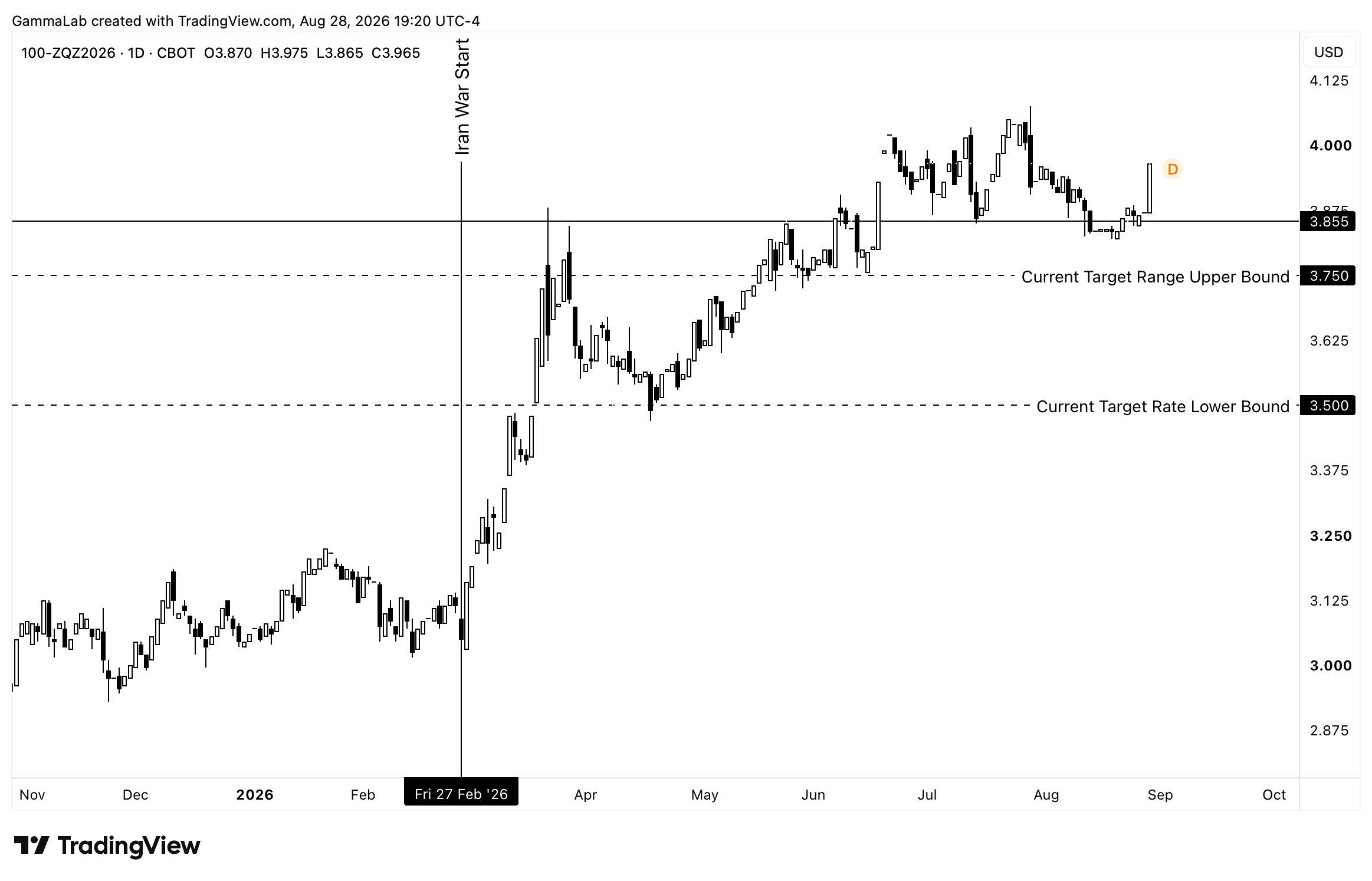
Chart above: The implied Fed Funds rate for December jumped higher today, ending the week at 3.97% (well above the current target range).
The macro calendar was busy. Personal income beat at 0.4%, while July PCE, durable orders, and Q2 GDP are covered in Wednesday's recap below, and the week closed on a sharp Chicago PMI contraction miss Friday. Earnings were also a factor, with Nvidia, Salesforce, and a wave of software and retail reports driving individual sessions.
Monday
The S&P 500 fell 0.3% as a rotation out of technology, momentum, and growth into defensive and value positioning defined the session, with the equal-weight index up 0.1% illustrating how concentrated the damage was. Bessent launched Operation Economic Outcast against Iran, sanctioning nearly 60 entities across nuclear, missile, cyber, oil, and financial networks and flagging five sectors for potential secondary sanctions, yet oil fell, with the WTI Crude Oil ETF leading the day at -1.8%. Consumer Staples led sectors at +1.7% and Financials added 1.3%, while Technology lagged at -1.8% as Seagate dropped 6.5%, Micron fell 5.8%, and Nvidia extended its losing streak to a seventh session at -2.9%. Trump escalated the trade rupture with Canada, announcing auto and steel tariffs rising to 50% effective January 1, 2027. Nvidia notified customers of AI chip price increases above 15% and disclosed a series of AI infrastructure partnerships alongside a potential Perplexity investment.
Tuesday
The S&P 500 rose 0.3% as gains concentrated in semiconductors and biotech, with the Strait of Hormuz story shifting incrementally toward diplomacy. Trump confirmed the US Navy had cleared and detonated all mines from the strait, and with Iran-Oman talks on an interim shipping framework advancing, crude sold off, sending the WTI Crude Oil ETF down 4.6% and pulling the 10-year yield down 7 basis points to 4.63%. Technology led at +0.9%, with Advanced Micro Devices up 4.9% and Super Micro Computer surging 9.4%. Canada formally retaliated with 15% to 50% levies on roughly $20 billion of US goods. August Consumer Confidence came in at 89.4, below the 90.6 consensus, and July New Home Sales of 607,000 missed expectations.
Wednesday
The S&P 500 closed flat as after-hours earnings, a major Meta Platforms legal settlement, and continued Hormuz diplomacy competed for attention. Crude extended its decline, with US futures settling at $82.36, down 3.1%, and the Soybean ETF led the tracked universe on the day at +1.8%. Q2 GDP printed at 1.5% in line, July PCE prices rose 0.2% above the 0.1% expected, and durable orders came in at 1.1% versus a 0.5% estimate. Industrials led sectors at +1.1% while Health Care fell 1.0%. After the close, Nvidia reported Q2 revenue of $96.22 billion with adjusted EPS of $2.22 and guided Q3 to $108.0 billion, Salesforce beat by $2.63 and raised full-year revenue guidance, and Meta reached a settlement with 51 state attorneys general worth at least $12.1 billion.
Thursday
The S&P 500 rose 0.7%, but the gain was almost entirely a Salesforce-led enterprise software surge, with the equal-weight index down 0.3% and every sector outside technology finishing lower. Salesforce jumped 22.6%, its largest single-day gain since August 2020, on raised guidance and its Claudeforce partnership, while Nvidia added 8.7% after confirming an expanded AWS GPU deployment and raising strategic supply commitments to $279 billion from $119 billion. The AI bid lifted the cybersecurity complex, with CrowdStrike up 20.5% and Palo Alto Networks up 12.8%. On the geopolitical front, Trump signed a preliminary Versailles agreement aimed at reopening the Strait of Hormuz, and with flows recovering the WTI Crude Oil ETF led the day at +2.1% as WTI settled at $83.53. Initial jobless claims came in at 203,000 below the 210,000 consensus, while the advance goods trade deficit widened to -$118.8 billion, and Hormel Foods fell 10.2% on weak results.
Friday
The S&P 500 fell 0.2% as Warsh's hawkish Jackson Hole address triggered a sharp repricing of September rate-hike expectations, lifting Treasury yields to multi-month highs. The probability of a September hike rose to roughly 57% from 35%, the 2-year yield settled up 12 basis points to 4.35%, and the Gold ETF led the tracked universe lower at -3.2% as rising yields weighed on the metal. The rate shock hit semiconductors hardest, with the PHLX Semiconductor Index down 3.5%, Nvidia off 4.6%, and Lam Research down 5.2%, while Financials gained 0.4% and Consumer Discretionary rose 1.1% on Amazon's 4.0% advance. The August Chicago PMI printed at 47.1 against a 57.0 consensus, a deep contraction miss, while Michigan sentiment came in at 51.7. PayPal fell 12.7% after Bloomberg reported the Advent and Stripe consortium abandoned its planned buyout, and Marvell Technology dropped 10.3% despite a revenue beat.
Gamma Situation
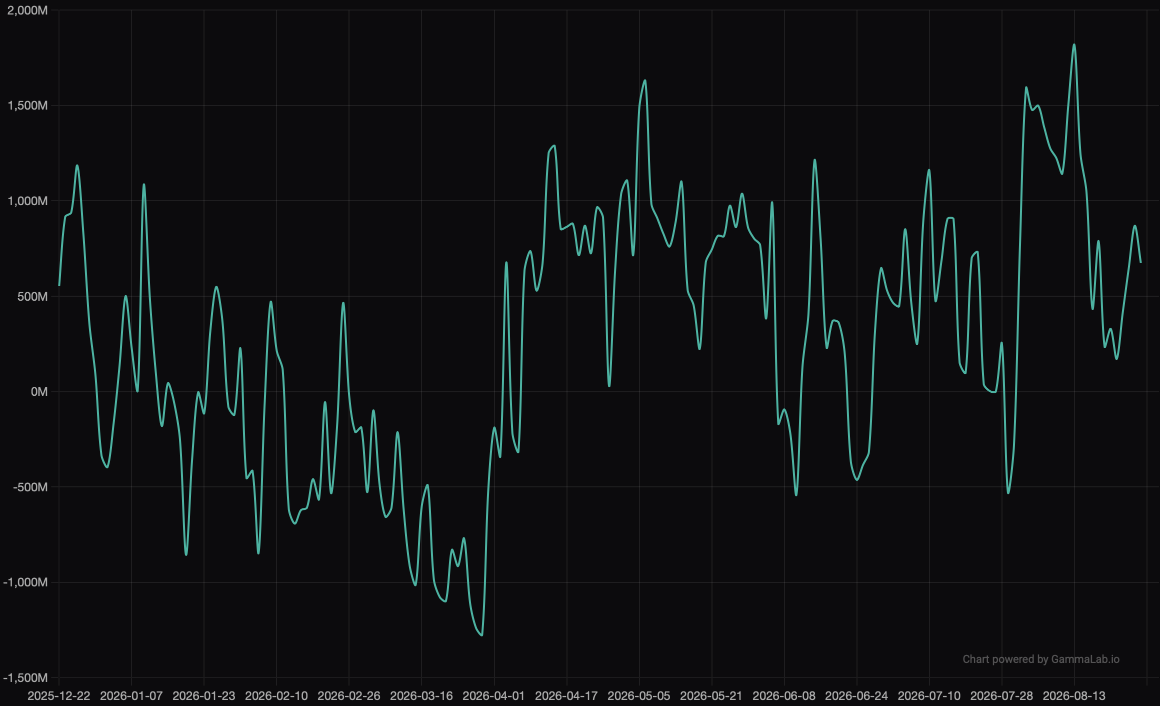
SPX gamma exposure (chart below) closed the week at $674 mln, up from $171 mln at the start of the week, a $503 mln increase as dealers built long gamma through the run higher in spot. The gamma flip level was essentially unchanged, edging down 4 points to 7645 from 7650, even as spot rose to close at 7721 from 7670. With spot holding well above the flip and dealer long gamma extended, the setup points to a comparatively pinned tape into next week.
Systematic Situation
CTA equity exposure fell $6B over the week to +$56B, from +$62B a week earlier. That shift wasn't material enough to chart this week.
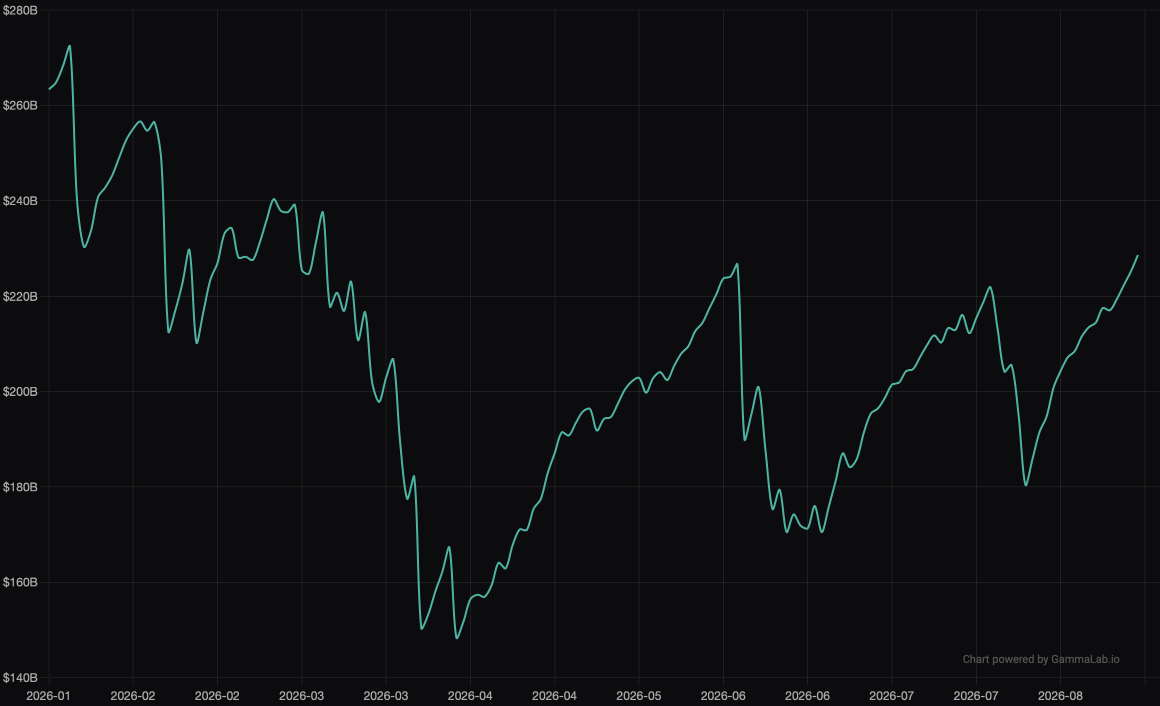
Vol-control notional exposure rose $12B over the week to +$229B, from +$217B, a swing large enough to clear this week's materiality bar as realized volatility stayed contained through the run higher (chart below).
Earnings Season
Results have skewed positive, with EPS beating consensus estimates by a market-cap-weighted 17.5% and revenue beating by 3.5%.
This is a post from GammaLab — real-time market intelligence powered by AI. Log in or subscribe to access the full platform.